STAGE 2: BUILD REAL SKILL
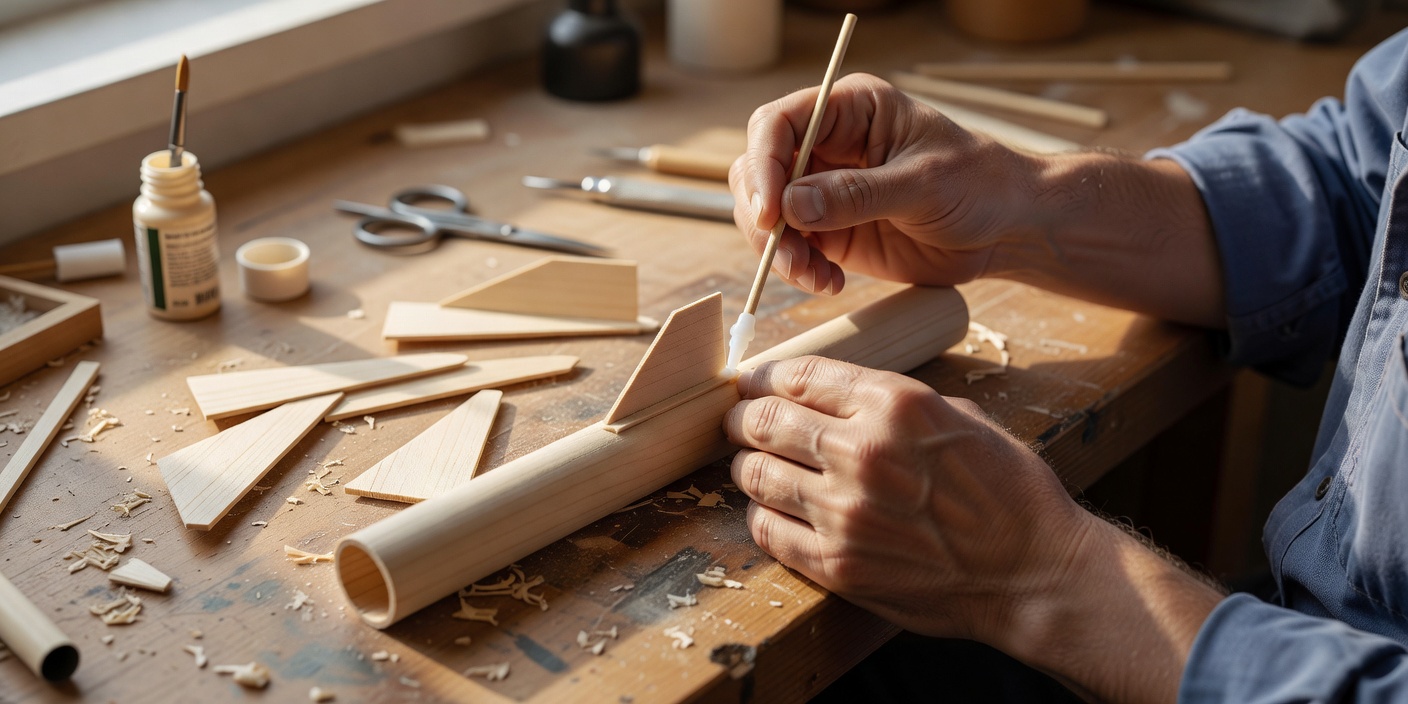
Theory alone does not fly. In Stage 2, you act on the structural knowledge acquired in Stage 1. Precision at the workbench ensures safety and stability on the launch pad.
THE ART OF THE FILLET
Fins cannot merely be tacked onto the side of a body tube. At high velocities, aerodynamic flutter will rip poorly attached fins from the airframe. You must execute a proper adhesive fillet.
A fillet is a smooth, concave bead of glue run along the joint where the fin meets the tube. Apply wood glue (aliphatic resin) in a thin line. Run a shaped applicator or a gloved finger along the seam to smooth it. Allow it to cure fully in a horizontal position before rotating to the next fin. This distributes stress across a wider surface area.
RECOVERY SYSTEM PACKING
The ejection charge is violent. If the recovery parachute is packed incorrectly, the hot gases will melt the plastic canopy, resulting in a ballistic return. Follow this rigid order of operations:
- Recovery Wadding: Insert 3-4 sheets of flame-resistant wadding. Push it down until it sits just above the engine mount. It must create a seal.
- Folding: Fold the parachute canopy in half, then into quarters, creating a wedge. Bring the shroud lines neatly down the center.
- Rolling: Roll the canopy tightly into a cylinder.
- Insertion: Slide the rolled canopy into the tube above the wadding. Do not pack it so tightly that friction prevents it from sliding out.
PROCEED TO NEXT STAGE
With a structurally sound rocket assembled and packed, you must now select the appropriate power and configuration for your flight.
BEGIN STAGE 3